
Surface vs. Depth Filtration: Which Is Right for Your Industrial Process?
Choosing an industrial filter requires more than matching its dimensions and micron rating. You also need to understand how the filter captures contaminants, how it behaves as it loads, and whether it can maintain the required fluid quality throughout its service life.
Surface filtration captures particles mainly at a filtering surface. Depth filtration captures particles within the thickness of a porous medium. That difference affects contaminant capacity, cleaning options, pressure drop, and maintenance requirements.
Neither approach is universally better. A cleanable surface filter may suit a process handling recoverable solids, while a depth filter may be a stronger candidate for capturing a broad distribution of fine particles. Some processes benefit from using both.
THE SHORT ANSWER
Evaluate surface filtration when screening, solids recovery, or cleaning is central to the duty. Evaluate depth filtration for internal capture of fine or mixed-size particles. Confirm either choice against outlet quality, pressure drop, and actual operating conditions.
This guide explains surface vs. depth filtration and provides practical criteria for selecting an industrial filter.
What Is Surface Filtration?
Surface filtration separates particles primarily at the upstream surface of a filtering medium. Fluid passes through openings in the medium, while particles that cannot pass through those openings remain on the surface.
A woven wire screen is a straightforward example. Its openings provide a physical barrier to particles, although actual retention also depends on particle shape, orientation, and operating conditions.
As solids accumulate, they may form a filter cake. This additional layer can capture smaller particles, but it also adds resistance to flow.
Common Surface Filtration Media
Examples include:
- Woven wire mesh.
- Wedge wire screens.
- Certain sintered wire mesh structures.
- Surface membranes supported by another material.
These examples describe typical behavior rather than fixed rules. A multilayer filter can combine surface capture with retention inside its structure.
When Surface Filtration Is Useful
Surface filtration is worth considering when the process needs a defined screening function, when captured solids must be recovered, or when the filter is designed for repeated cleaning.
For example, a suitable metal mesh element may allow solids to be removed by backwashing or another approved cleaning method. Whether cleaning is effective depends on the contaminant, the filter construction, and the process conditions.
A surface filter can still clog rapidly if sticky, deformable, or very fine contaminants block its openings.
What Is Depth Filtration?
Depth filtration captures particles within a porous medium as fluid travels through its thickness.
The medium contains a network of flow paths. Particles can become trapped at constrictions, intercepted by fibers, or retained through interactions with the internal surfaces. Capture therefore depends on more than a single opening size.
Some depth media use a graded structure, with a more open upstream region and a finer downstream region. This arrangement can distribute contaminant loading through the medium instead of concentrating it entirely at the entrance.
Common Depth Filtration Media
Examples include:
- Melt-blown polypropylene cartridges.
- String-wound cartridges.
- Glass fiber and synthetic fiber media.
- Sintered metal fiber felt.
- Porous sintered powder structures.
The actual capture behavior depends on the design. Not every product made from these materials has the same retention efficiency, contaminant capacity, or operating limits.
When Depth Filtration Is Useful
Depth filtration is often a candidate when a process contains fine particles or a broad particle size distribution.
Using the internal volume of the medium can provide substantial contaminant storage. However, that advantage depends on whether particles penetrate the structure as intended. If the upstream face blinds quickly, much of the available depth may remain unused.
Many fibrous depth cartridges are replaced after loading. Some metal depth media can be cleaned, but successful regeneration requires a suitable construction, an effective cleaning procedure, and verification afterward.
Surface vs. Depth Filtration: Key Differences
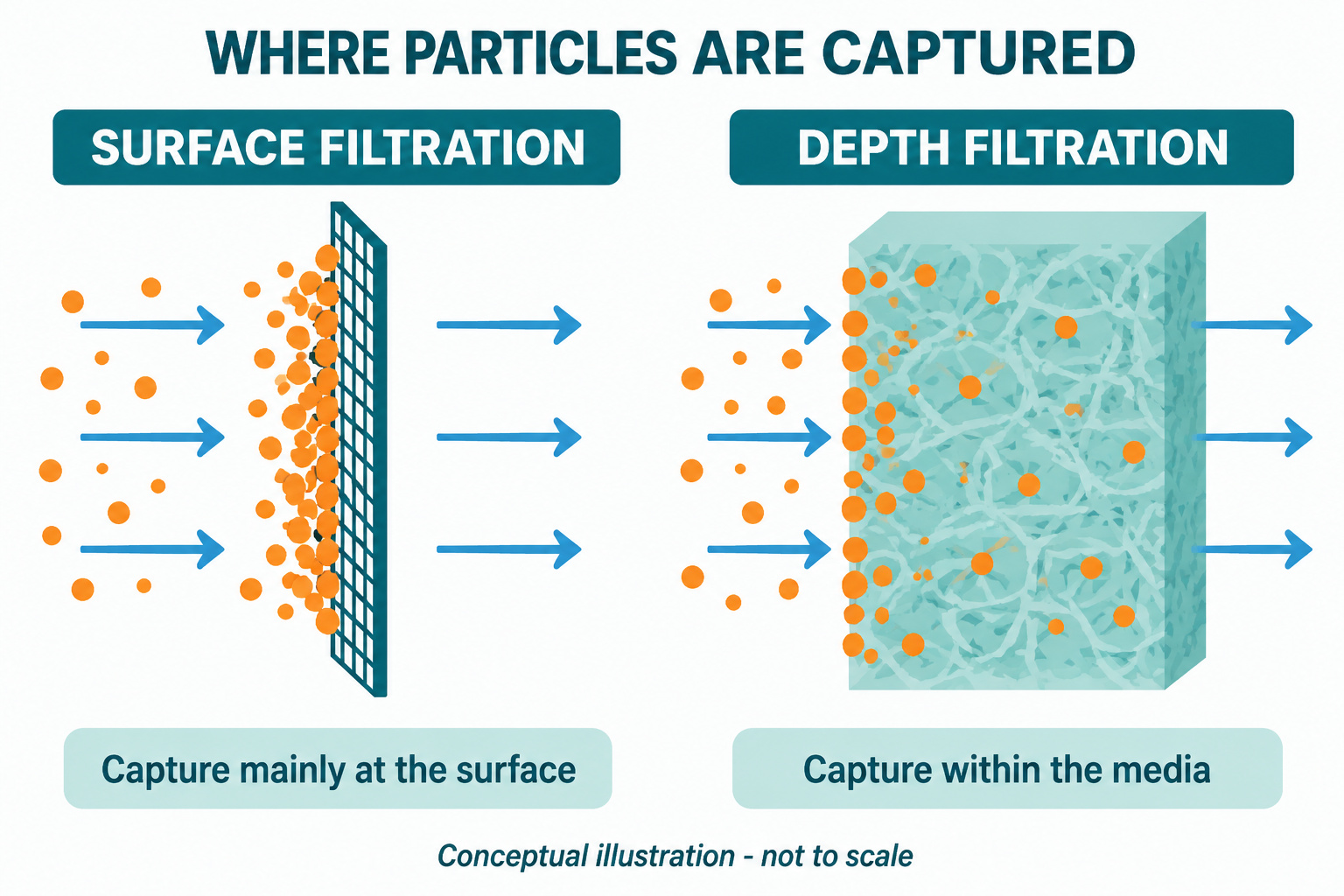
The diagrams show typical capture locations. Actual media may combine surface and depth mechanisms; the illustration is not to scale.
The following comparison describes typical tendencies. Use product-specific performance data to make the final selection.
On smaller screens, swipe the table horizontally to view all columns.
| Selection factor | Surface filtration | Depth filtration |
|---|---|---|
| Main capture location | Primarily at the upstream filtering surface | Within the thickness of the porous medium |
| Capture behavior | Often dominated by screening at openings, followed by cake formation | Combines internal trapping and particle interactions with the medium |
| Contaminant storage | Depends strongly on surface area, cake properties, and cleaning method | Can use internal media volume when loading is well distributed |
| Cleaning potential | Often favorable for suitably designed metal screens and meshes | Varies widely; many cartridges are disposable, while some metal media are cleanable |
| Sensitivity to contaminants | Sticky or deformable solids can blind openings | Contaminants can block entrances or become difficult to remove internally |
| Pressure drop | Depends on openings, area, flow, viscosity, and accumulated cake | Depends on permeability, thickness, area, flow, viscosity, and internal loading |
| Typical applications | Screening, solids recovery, cleanable process filtration | Fine-particle control, clarification, and equipment protection |
| Main selection mistake | Assuming a cleanable material guarantees easy cleaning | Assuming thicker media automatically provides longer service life |
Neither filtration mechanism guarantees higher efficiency, lower pressure drop, or longer life. Those are performance characteristics of the complete filter under specified conditions.
Filter Material Does Not Tell the Whole Story
“Stainless steel,” “polypropylene,” and “glass fiber” identify materials. They do not fully describe the filtration mechanism.
For example:
- Woven stainless steel mesh commonly behaves as a surface medium.
- Sintered stainless steel fiber felt can provide depth capture.
- A multilayer sintered mesh element may capture mainly at a fine control layer while other layers provide support.
- A pleated cartridge may use surface media, depth media, or a composite structure.
Pleating increases the available media area within a given envelope. It does not, by itself, make a filter a surface or depth filter.
Ask the supplier to identify the filtering layer, the support layers, and the performance evidence for the finished element.
How to Choose the Right Filtration Method
Start with the process requirement, then evaluate which filter construction can meet it.
Define the Required Outlet Quality
Identify what the filter must protect and what contamination level is acceptable.
An upstream screen protecting a pump has a different task from a fine filter protecting a sensitive hydraulic component. A process filter intended to improve product quality may require different acceptance criteria again.
Define the target using measurable requirements where possible, such as particle counts, retention efficiency at a stated particle size, or an agreed product quality test.
Characterize the Contaminants
Consider:
- Particle size distribution.
- Solids concentration and changes during operation.
- Particle shape and hardness.
- Whether contaminants are sticky, fibrous, compressible, or gelatinous.
- Whether solids must be discarded or recovered.
A high solids concentration does not automatically mean a depth cartridge is the best solution. Heavy loading may require upstream settling, separation, or a continuously cleaned filter before fine filtration.
Check the Fluid and Operating Conditions
Record the fluid composition, minimum and maximum temperature, normal and peak flow, viscosity, and operating pressure.
For liquids, viscosity is especially important. A filter that has acceptable pressure drop with warm fluid may behave very differently during a cold start.
Also distinguish system pressure from differential pressure. A housing’s pressure rating does not establish the element’s resistance to collapse, reverse flow, or repeated pressure changes.
Use the Process Conditions to Narrow the Options
On smaller screens, swipe the table horizontally to view all columns.
| Process condition | Candidate to evaluate | Verification needed |
|---|---|---|
| Coarse, rigid particles with a need for regular cleaning | Surface screen or mesh | Opening size, effective area, solids discharge, and cleaning effectiveness |
| Fine particles distributed across a range of sizes | Depth or composite medium | Efficiency across relevant particle sizes and loading performance |
| Valuable solids must be recovered | Surface or cake filtration arrangement | Product recovery, cake release, and required filtrate quality |
| High temperature or demanding chemical conditions | Compatible metal surface or depth medium | Alloy, seals, joints, corrosion resistance, and complete assembly limits |
| Coarse debris and fine contamination occur together | Staged filtration | Loading balance, pressure budget, and final outlet quality |
| Sticky or gelatinous contamination | Application testing before selection | Blinding, internal fouling, cleaning recovery, and possible pretreatment |
These are starting points for evaluation, not automatic product recommendations.
Why Micron Rating Alone Is Not Enough
Two filters labeled “10 μm” may deliver different results.
One rating may describe a nominal retention level. Another may refer to a stated efficiency under a defined test. Differences in challenge particles, flow, fluid properties, and test endpoints can make apparently similar ratings difficult to compare.
The term “absolute” should also be supported by a defined efficiency and test method. It should not be treated as a complete specification by itself.
An Incomplete Purchase Specification
Supply a 10 μm stainless steel filter cartridge with the same dimensions as the existing element.
This wording identifies a material, a particle size label, and a fit requirement. It leaves important questions unanswered:
- What efficiency is required at 10 μm?
- What fluid and temperature will the filter encounter?
- What flow rate must it handle?
- What initial pressure drop is acceptable?
- What differential pressure can the element withstand?
- Must it be cleaned and reused?
A More Useful Specification
Supply a filter element for the stated process fluid and operating temperature range. Confirm dimensions, connection, flow direction, and seal compatibility. Specify the required retention efficiency at the target particle size, the applicable test method, clean pressure drop at design flow and viscosity, and allowable differential pressure. If reuse is required, provide the cleaning procedure and post-cleaning acceptance criteria.
The actual values should come from the process requirements and equipment documentation.
This approach allows a surface filter and a depth filter to be compared against the same duty. It also helps identify when two elements that fit the same housing are not functionally interchangeable.
For hydraulic applications, ISO 16889 provides a multipass test framework for evaluating filter performance. Results should still be reviewed for the relevant test conditions and their applicability to the intended system.
When Should You Combine Surface and Depth Filtration?
Staged filtration can be useful when one element would otherwise have to handle very different contaminant populations.
A surface prefilter may remove larger debris before a depth filter captures finer particles. This arrangement can reduce the burden on the downstream element, provided the first stage removes a meaningful portion of the incoming load.
However, the order is application dependent. In other systems, depth filtration protects a downstream membrane or another final barrier.
An Illustrative Process Example
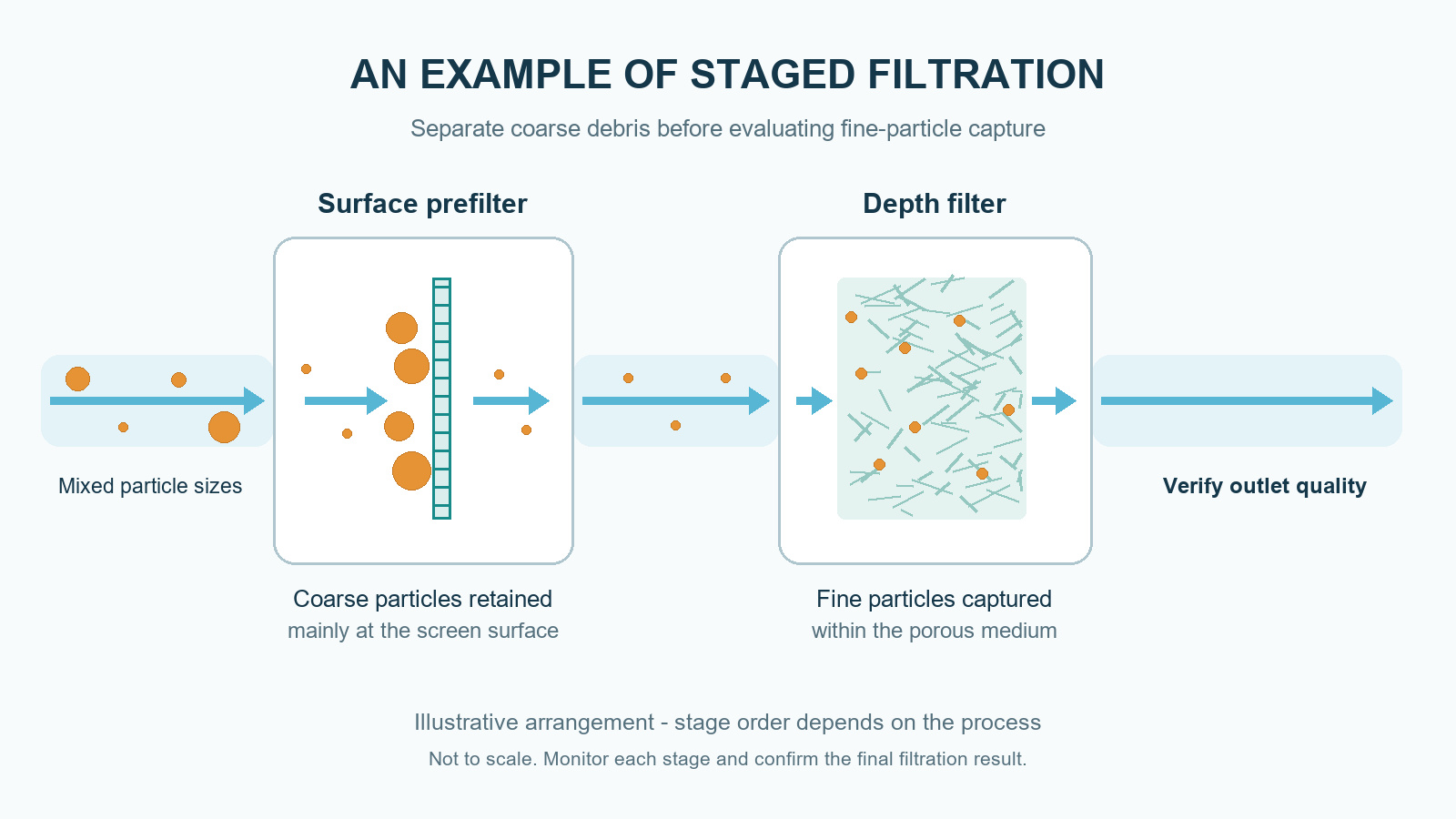
One possible staged arrangement. Stage order and filtration ratings must be selected for the actual process; outlet quality requires verification.
Consider a recirculating process liquid containing intermittent coarse fragments and a continuing background of fine particles.
A possible evaluation sequence is:
- Use an appropriately sized screen to intercept coarse fragments.
- Evaluate a downstream depth element against the required fine-particle removal target.
- Measure differential pressure separately across both stages.
- Sample the fluid downstream of the final stage.
- Compare performance with the existing arrangement over representative operating conditions.
This is an illustrative design approach, not a documented customer result.
The first stage adds housing cost, pressure drop, and maintenance. It is justified only if the measured improvement in operation outweighs those additions.
Do not select filtration stages using a universal micron ratio. Base the sequence on the actual particle distribution, the retention performance of each stage, and the available pressure budget.
How to Compare Operating Cost and Validate Performance
The lowest purchase price does not necessarily produce the lowest filtration cost.
A reusable element may reduce replacement purchases while adding cleaning labor, chemicals, inspection, and waste handling. A disposable depth cartridge may simplify maintenance but require more frequent replacement under a demanding contaminant load.
Compare costs over the same production volume or operating period.
A practical calculation is:
Filtration cost per unit of product = total filtration-related cost ÷ accepted production output
Include element purchases, cleaning, labor, disposal, energy attributable to filtration, and production losses where they can be measured.
Record the Right Data During a Trial
On smaller screens, swipe the table horizontally to view all columns.
| Measurement | What it helps establish |
|---|---|
| Clean differential pressure at recorded flow, temperature, and viscosity | Whether initial resistance is acceptable |
| Differential pressure over time | How the filter loads during operation |
| Downstream particle count or relevant quality result | Whether the required filtration outcome is maintained |
| Volume processed before the agreed endpoint | Practical service capacity |
| Cleaning time and post-cleaning performance | Whether reuse is effective and repeatable |
| Replacement labor and interruption time | The maintenance burden |
A low pressure drop is not proof of successful filtration. Poor sealing, bypass flow, or media damage can allow contamination through with little resistance.
Likewise, a rising pressure drop does not always mean the element has reached its contaminant capacity. Changes in viscosity or flow can contribute.
Set acceptance criteria before testing. A candidate should meet outlet quality, pressure limits, and mechanical compatibility requirements throughout the intended duty. If it cannot, a longer operating interval or lower element price does not make it the better choice.
Frequently Asked Questions
Does depth filtration remove dissolved salts?
Conventional particle depth filtration does not remove dissolved salts simply by trapping particles. Dissolved contaminants require a suitable separation or treatment process, such as reverse osmosis or ion exchange, depending on the application.
Can a surface or depth filter remove water from hydraulic oil?
A particle filter should not be assumed to remove water. The appropriate treatment depends on whether the water is free, emulsified, or dissolved. Water removal may require specialized coalescing, water-absorbing, or dehydration equipment.
Can an existing surface filter be replaced with a depth filter in the same housing?
Only after technical verification. Matching dimensions is insufficient. Check sealing, flow direction, fluid compatibility, retention performance, clean pressure drop, element strength, and any bypass arrangement before making the change.
Is a depth filter suitable for final filtration?
It can be, if its verified performance meets the final process requirement. The label “depth filter” does not establish a validated microbial barrier, a particular particle removal efficiency, or suitability for a critical application.
Choosing between surface and depth filtration starts with the required result: acceptable fluid quality at the specified flow, temperature, pressure, and maintenance conditions.
TOPEP offers industrial filtration products including hydraulic oil filter elements, stainless steel mesh and sintered filter elements, and water filter cartridges. To discuss a suitable construction, provide your fluid, contaminant information, required filtration performance, operating conditions, and existing element drawing or dimensions.
Discuss your filtration requirements
Send your fluid, contaminant information, operating conditions, required filtration performance, and element drawing or dimensions.
Contact TOPEP about your application →- Why Does Water Contamination Occur in Hydraulic Oil and How Can It Be Removed?
- Why Does Your Hydraulic Oil Filter Clog Frequently?
- What Is the Difference Between an Oil Filter and a Hydraulic Filter?
- How to Improve Dust Collection Efficiency
- Why Do Industrial Filters Fail?
- Stainless Steel Filter Cartridge Applications in High Temperature Industries
- How to Select the Right Industrial Filter Element for Your Application
- How to Identify the Right Replacement Filter Element