
How to Improve Dust Collection Efficiency
Industrial dust collection systems are widely used in manufacturing industries to control airborne particles, protect production equipment, and maintain a cleaner working environment. Applications such as metal processing, welding, powder coating, woodworking, chemical production, and pharmaceutical manufacturing all require reliable dust filtration solutions.
Although the dust collector itself plays an important role, the performance of the entire system largely depends on the quality and suitability of the filter cartridge. A properly selected filter cartridge can improve filtration efficiency, maintain stable airflow, reduce energy consumption, and extend equipment service life.
Many filtration problems are caused by incorrect filter selection rather than equipment failure. Using a filter cartridge with unsuitable filter media, insufficient filtration area, or poor dust release performance may result in increased pressure drop, frequent cleaning cycles, reduced airflow, and higher operating costs.
Understanding how filter cartridges work and selecting the right solution according to specific working conditions is essential for achieving efficient and stable dust collection performance.
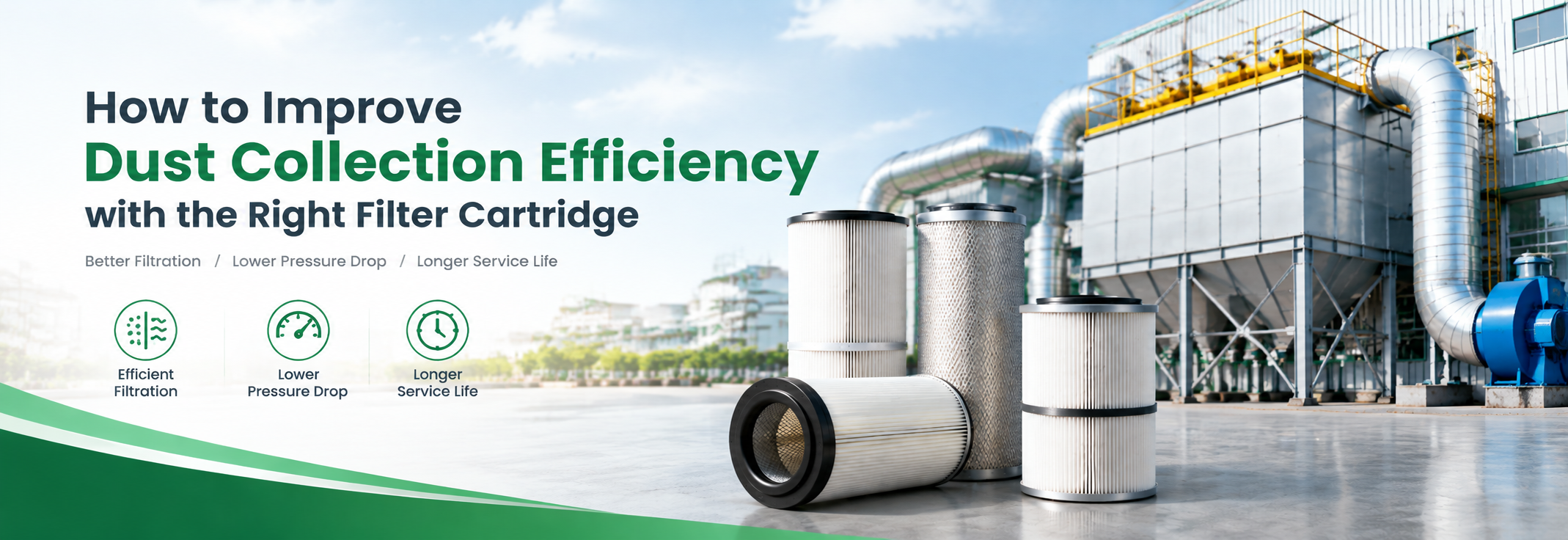
1. Understanding How Dust Collector Filter Cartridges Work
A dust collector filter cartridge is the core filtration component responsible for separating dust particles from contaminated air. During operation, dusty air enters the filtration system and passes through the filter media. Dust particles are captured on the surface of the filter media, while clean air flows through the cartridge and returns to the production environment.
The filtration performance of a cartridge depends on several factors, including filtration efficiency, airflow resistance, dust holding capacity, and cleaning performance. A high-quality filter cartridge should provide efficient particle capture while maintaining low pressure drop during continuous operation.
During the filtration process, a dust layer gradually forms on the filter surface. This layer can improve filtration efficiency by capturing smaller particles, but excessive dust accumulation will increase resistance and reduce airflow. Therefore, effective dust release during cleaning cycles is also an important factor affecting filter performance.
A suitable filter cartridge design helps maintain a balance between filtration efficiency and operating stability.
2. Selecting the Right Filter Media for Different Dust Applications
Filter media selection is one of the most important factors influencing dust collection efficiency. Different industrial applications generate different types of dust, and each type has unique requirements regarding particle size, temperature resistance, moisture resistance, and chemical compatibility.
Polyester filter media is one of the most commonly used materials for industrial dust collection because it offers good mechanical strength, stable performance, and excellent cost efficiency. It is suitable for general dust filtration applications where durability and reliability are required.
For applications involving fine particles or strict emission requirements, PTFE membrane filter cartridges provide improved filtration performance. The microporous PTFE surface layer helps capture smaller particles while maintaining good airflow characteristics.
In environments where static electricity may create safety risks, antistatic filter media can help reduce electrostatic accumulation and improve operational safety.
Choosing the correct filter media according to dust characteristics can significantly improve filtration performance and reduce unnecessary maintenance costs.
.jpg)
3. Improve Filtration Performance Through Pleated Filter Cartridge Design
The structural design of a filter cartridge directly affects filtration efficiency and service life. Compared with traditional filter elements, pleated filter cartridges provide a larger filtration area within a compact installation space.
A larger filtration area allows the cartridge to handle higher airflow while maintaining lower pressure resistance. This makes pleated filter cartridges especially suitable for industrial dust collectors that require continuous operation and high filtration capacity.
However, effective pleated design requires more than simply increasing the number of pleats. If pleats are too dense, dust may accumulate between the layers and reduce cleaning efficiency. Professional filter manufacturers optimize pleat spacing, filter media selection, and airflow direction to achieve better performance.
A well-designed pleated filter cartridge can improve dust capture efficiency, reduce operating pressure, and extend replacement intervals.
4. Maintain Stable Pressure Drop and Reduce Energy Consumption
Differential pressure is an important indicator for evaluating filter cartridge performance. As dust accumulates, the resistance across the filter increases. When pressure drop becomes too high, the dust collector fan needs to consume more energy to maintain airflow.
Selecting a filter cartridge with suitable filtration area and good dust release characteristics helps maintain stable pressure drop during operation.
Regular monitoring of differential pressure allows operators to identify filter conditions and replace cartridges before they negatively affect production efficiency.
- How Bubble Point Testing Helps Check the Quality of Sintered Powder Filters
- Surface vs. Depth Filtration: Which Is Right for Your Industrial Process?
- Why Does Water Contamination Occur in Hydraulic Oil and How Can It Be Removed?
- Why Does Your Hydraulic Oil Filter Clog Frequently?
- What Is the Difference Between an Oil Filter and a Hydraulic Filter?
- Why Do Industrial Filters Fail?
- Stainless Steel Filter Cartridge Applications in High Temperature Industries
- How to Select the Right Industrial Filter Element for Your Application