
How Bubble Point Testing Helps Check the Quality of Sintered Powder Filters
Two metal filter cartridges can look almost identical. Their dimensions match, the surfaces look clean, and both are described as sintered powder filters. But appearance alone cannot tell you whether the porous structure contains an unusually large flow path or a defect that deserves closer inspection.
Bubble point testing helps make an important part of that hidden structure easier to check. By introducing gas into a properly wetted filter and observing when sustained bubbles emerge, a technician can gather evidence about its larger connected pores and identify results that need investigation.
For buyers, the benefit is straightforward: a more informed conversation about filter quality before installation. You do not need to understand complicated formulas to know what the test does, how it works, and what questions to ask your supplier.
What Is Bubble Point Testing?
Bubble point testing is a method of checking a porous filter by measuring the gas pressure needed to push wetting liquid out of its larger connected passages.
First, a suitable liquid fills the pores. Gas pressure is then increased gradually on one side of the filter. When gas opens a continuous route through a larger passage, bubbles become visible on the liquid side.
The pressure at the defined onset of sustained bubbling is recorded according to the test method.
This is different from simply immersing a filter and looking for bubbles. The wetting liquid, pressure control, connection sealing, and observation method all affect the result. A useful test follows a repeatable procedure and compares the result with criteria appropriate to that filter.
The method is particularly useful for porous metal products because the openings are too small and complex to judge reliably by eye. It can complement dimensional inspection, visual checks, and other performance tests.
How Does the Principle Work? Think of Liquid Held in Tiny Openings
Imagine a small amount of liquid held in a narrow opening. Surface tension helps keep that liquid in place. Gas cannot immediately pass through; it needs enough pressure to move the liquid out of the way.
That is the basic idea behind a bubble point test.
In a sintered powder filter, metal particles are bonded together to create a rigid material with many interconnected pores. After wetting, liquid occupies those passages. As gas pressure rises, a larger connected passage generally opens before a smaller one under the same wetting conditions.
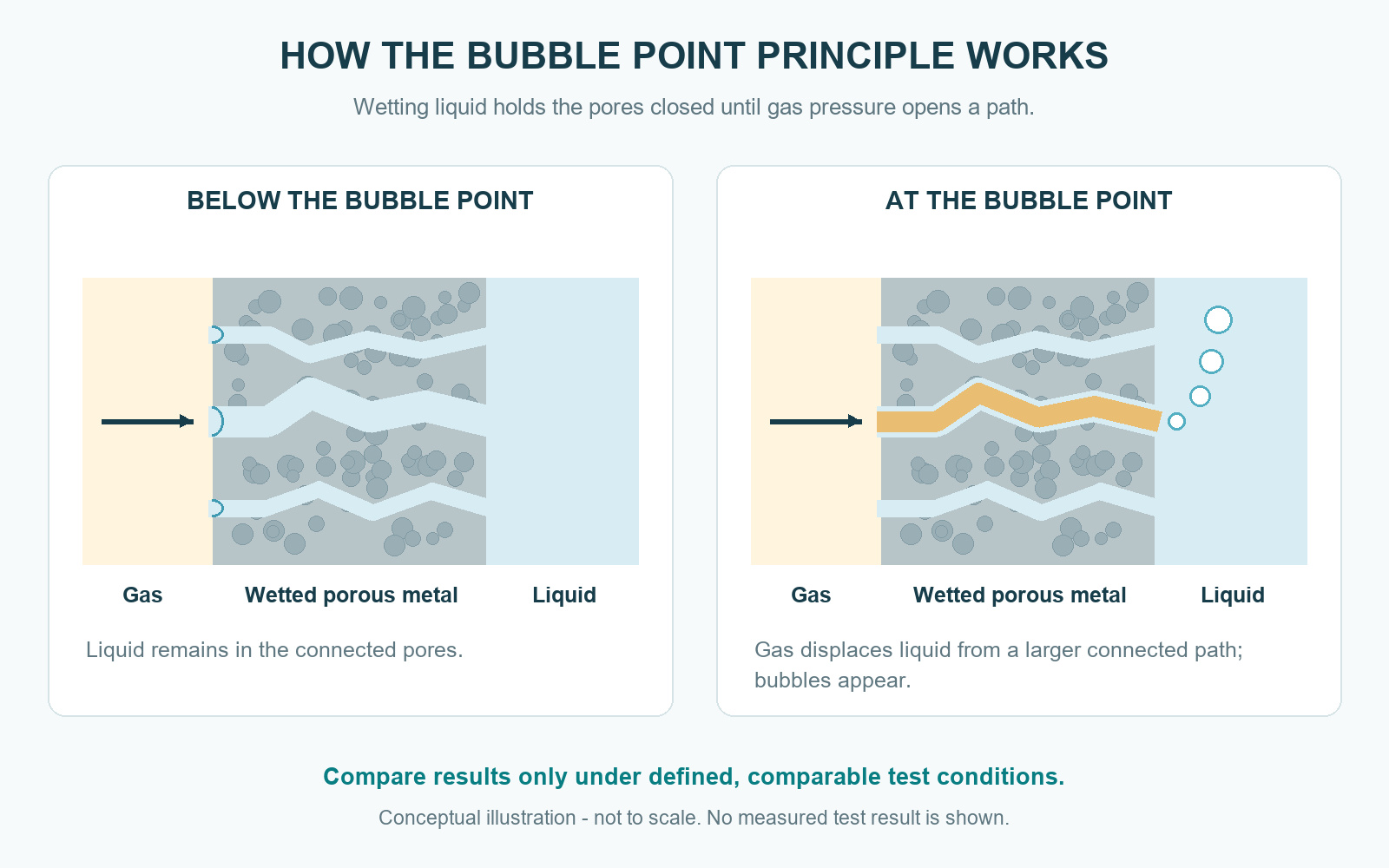
The illustration simplifies the porous structure. Bubble point depends on the liquid and test conditions as well as the connected pore geometry.
This gives the test its practical value: an unexpectedly low result or unusual bubbling pattern can prompt a closer look at the element, its sealing, or the test setup.
It does not mean that a higher reading is always better. Different filter grades have different structures and duties. The useful question is whether the reading is appropriate for the specified product and test conditions.
What Happens During a Bubble Point Test?
The exact equipment and procedure depend on the filter design and approved method. For a buyer, the process can be understood in five steps.
1. Wet the Filter Thoroughly
A suitable wetting liquid fills the porous material. Complete wetting matters because dry or partly wetted passages can allow gas to pass too easily and distort the result.
The liquid must be compatible with the filter and the testing procedure. Water is not automatically suitable for every material or test.
2. Connect and Seal the Element
The element is connected to a controlled gas supply. The fixture directs gas through the intended filtering wall and closes any routes that would let it escape elsewhere.
This step is essential. Bubbles from a loose fitting or an incorrectly sealed connection should not be mistaken for a defect in the porous material.
3. Increase the Gas Pressure Gradually
The operator raises the pressure in a controlled way while monitoring the test setup. Applying excessive pressure quickly can make the onset difficult to observe and may exceed the limits of the element or fixture.
There is no single test pressure that applies to every powder-sintered filter.
4. Observe the Sustained Bubble Formation
The operator watches for the bubbling condition defined by the method, commonly the onset of a sustained bubble stream.
A few isolated bubbles can have other causes, including trapped air. That is why controlled observation is more useful than a short video showing bubbles without the surrounding test information.
5. Record and Review the Result
The reading is recorded and checked against the agreed requirements for the element. If something looks unusual, the setup, wetting, seals, and element are reviewed before a conclusion is reached.
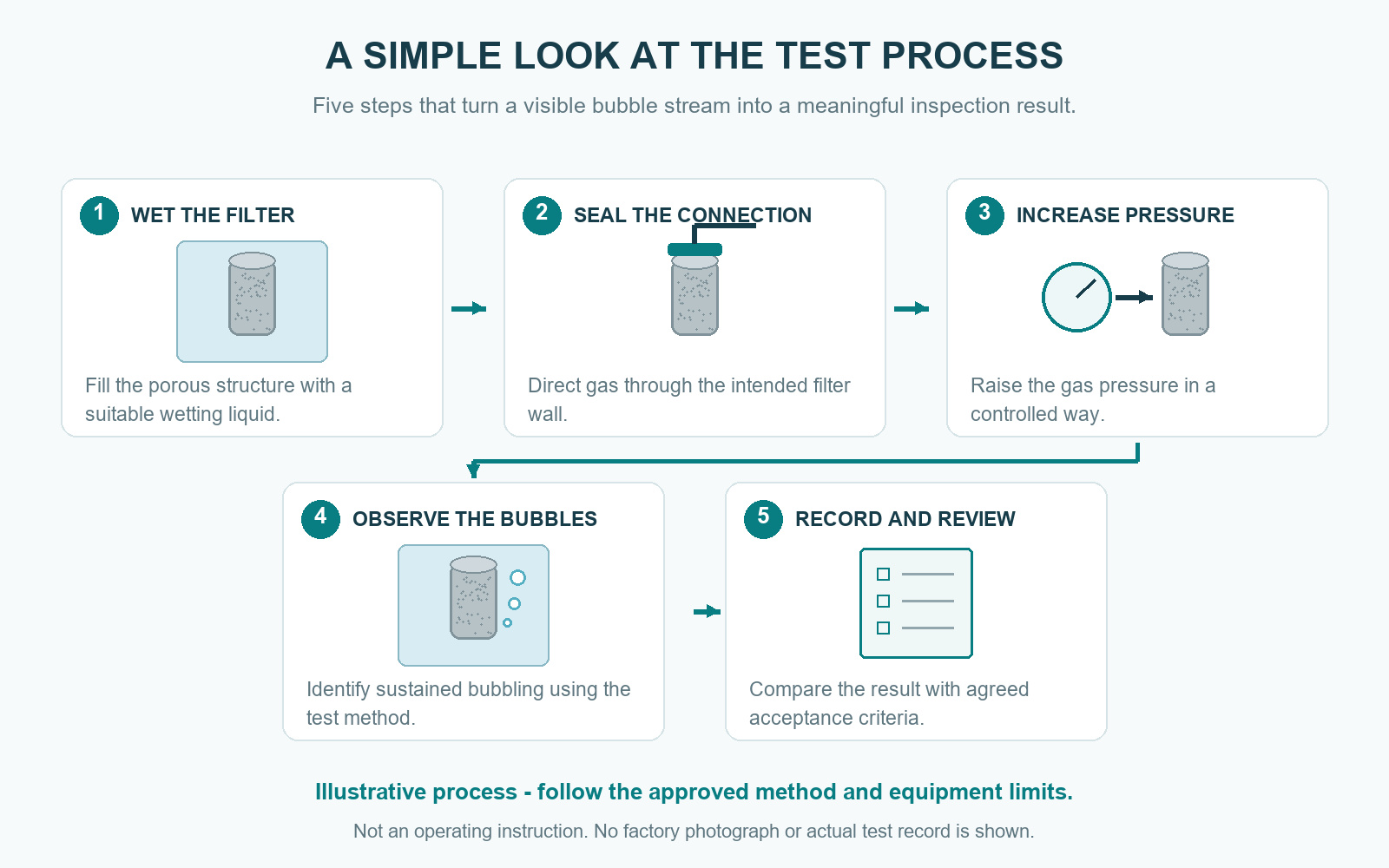
An overview for buyers, not an operating instruction. Testing should follow the applicable method and equipment limits.
Why Does Bubble Point Testing Matter When You Buy Filters?
The main value is not the bubbles themselves. It is the extra information they provide about a component you will rely on inside your equipment.
It Helps Identify Abnormal Flow Paths
An unexpected result can indicate a larger-than-expected connected opening or possible damage. It can also reveal a test-fixture problem that needs to be corrected.
Investigating these findings before installation is more useful than discovering a mismatch after the filter has entered service.
It Supports More Meaningful Consistency Checks
When comparable elements are tested using the same liquid, method, and conditions, the results can help highlight differences that deserve investigation.
Consistency does not mean every element must produce an identical number. It means the results are assessed against a defined range and interpreted for the specific product.
It Gives Purchasing and Engineering Teams Something Concrete to Review
“Good quality” is a broad promise. A clear inspection requirement is more useful.
Knowing what was checked, how the element was identified, and which acceptance criteria were used helps purchasing and engineering teams discuss the same requirement. It also makes repeat orders easier to define.
It Can Contribute to Checks After Cleaning
Some sintered metal filters are designed for cleaning and reuse. Where applicable, comparing bubble point results under equivalent conditions can contribute to an assessment after cleaning.
That assessment should also consider cleanliness, physical condition, flow resistance, and the manufacturer's instructions. An acceptable bubble point result alone does not prove that the element has been fully cleaned.
What Should a Buyer Look for in a Test Record?
You do not need a lengthy laboratory report for every purchase. But you should be able to connect an inspection statement to the product you are ordering.
| Check | Why it matters |
|---|---|
| Element model, drawing reference, or batch identification | Connects the result to the supplied product |
| Test method and wetting liquid | Explains how the result was obtained |
| Relevant conditions and acceptance criteria | Makes a pass or fail statement meaningful |
| Recorded result and inspection date | Provides a traceable record for review |
| Individual testing or batch sampling scope | Clarifies how much of the order the inspection represents |
For example, compare these two purchase requests:
Too vague: Please supply high-quality sintered filters with a bubble test.
More useful: Please confirm which inspection checks are available for this filter model, whether bubble point testing is applicable, and the proposed method, acceptance criteria, sampling scope, and records for our order.
The second request helps you agree on what “tested” actually means. It is especially helpful when ordering a replacement element or moving from a sample to a larger production order.
One result also has a clear boundary: bubble point testing is an integrity-related check, not a complete measurement of filtration efficiency, dirt-holding capacity, or service life. Those properties need their own suitable evidence. Used alongside the right inspections, it strengthens a quality assessment without asking one test to prove everything.
Choosing Sintered Powder Filters for Your Application
Inspection is most useful when the filter itself matches the job. Before comparing suppliers, define the fluid or gas, operating temperature, flow requirement, pressure conditions, installation dimensions, and filtration target.
A cartridge that fits the housing may still have an unsuitable material, pore structure, connection, or seal. If you are replacing an existing element, provide a drawing, original part number, or clear photographs together with the operating information.
TOPEP's sintered metal powder filter range includes different materials, dimensions, and connection configurations. The right choice depends on the application rather than appearance alone.
When you contact us, include any inspection requirements in the same inquiry. This allows product specifications, applicable checks, and documentation expectations to be discussed together before the order is finalized.
To prepare an inquiry, send:
- Your drawing, dimensions, sample information, or existing part number.
- The process fluid or gas and operating conditions.
- The required filtration rating and any specified performance criteria.
- Your inspection, sampling, and documentation requirements.
You can also learn more about TOPEP's company and filter manufacturing background. For elements already in service, our introduction to sintered filter care and maintenance provides related background; the actual cleaning procedure should suit the specific element and contamination.
Common Questions About Bubble Point Testing
Does a Bubble Point Test Damage the Filter?
It is generally intended as a non-destructive test when performed with a compatible liquid and within the element's and fixture's limits. Afterward, the filter may need suitable rinsing or drying before use, particularly where residual test liquid could affect the process.
Can I Compare Two Suppliers by Bubble Point Pressure Alone?
No. First check that the filter grade, wetting liquid, method, and relevant conditions are comparable. A pressure value without that context is not a reliable way to rank suppliers.
Is It the Same as an Air Leak Test?
Not exactly. A simple leak check looks for unintended gas escape. A bubble point test uses a wetted porous medium and a defined pressure-based observation to assess its connected pore structure. A setup leak must be ruled out so it does not confuse that assessment.
Must Every Sintered Powder Filter Have the Same Inspection Plan?
No. The plan depends on the product, its application, the agreed specification, and the purchase requirements. Confirm which checks apply and whether the scope is individual testing, sampling, or another agreed arrangement.
Looking for sintered powder filters with clearly defined quality requirements? Contact TOPEP with your drawing and operating conditions to discuss suitable filter options and the inspection requirements for your order.
- Surface vs. Depth Filtration: Which Is Right for Your Industrial Process?
- Why Does Water Contamination Occur in Hydraulic Oil and How Can It Be Removed?
- Why Does Your Hydraulic Oil Filter Clog Frequently?
- What Is the Difference Between an Oil Filter and a Hydraulic Filter?
- How to Improve Dust Collection Efficiency
- Why Do Industrial Filters Fail?
- Stainless Steel Filter Cartridge Applications in High Temperature Industries
- How to Select the Right Industrial Filter Element for Your Application